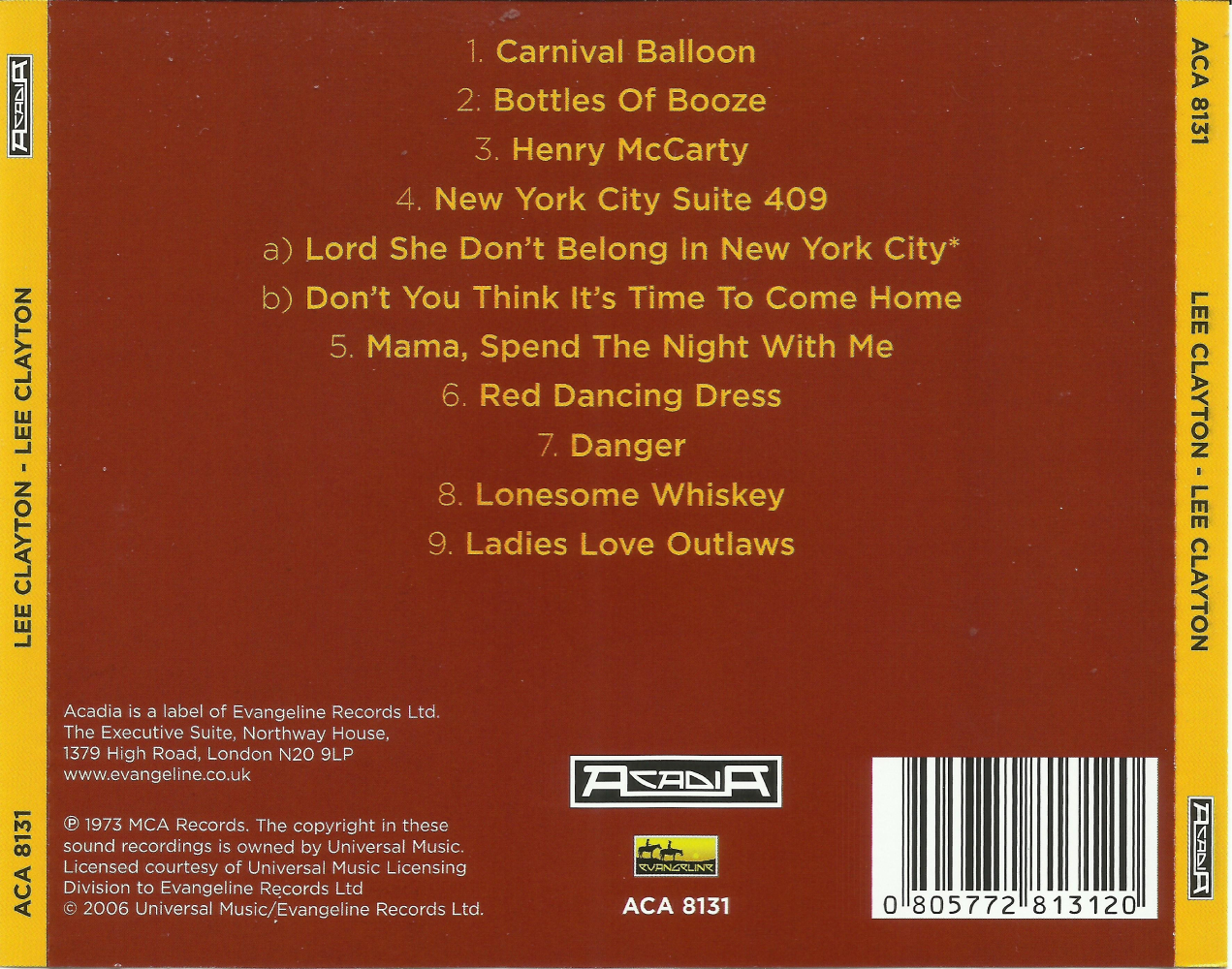
LEE CLAYTON : LEE CLAYTON
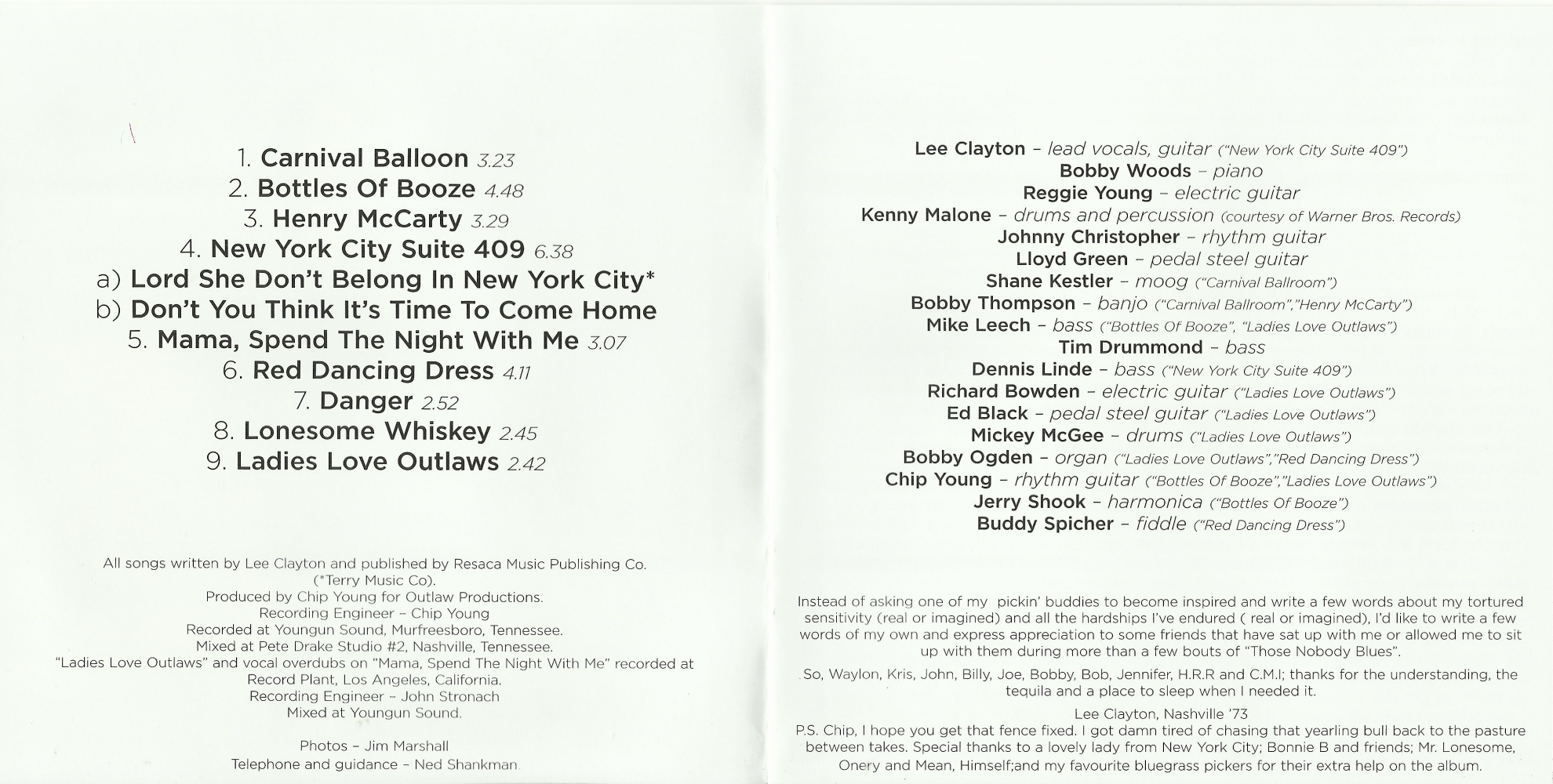
- Carnival Balloon
- Bottles Of Booze
- Henry McCarty
- New York City Suite 409
a. Lord She Don't Belong In New York City
B. Don't You Think It's Time To Come On Home - Mama, Spend The Night With Me
- Red Dancing Dress
- Danger
- Lonesome Whiskey
- Ladies Love Outlaws
Label : Acadia
Length : 33:55
Release Date : 1973
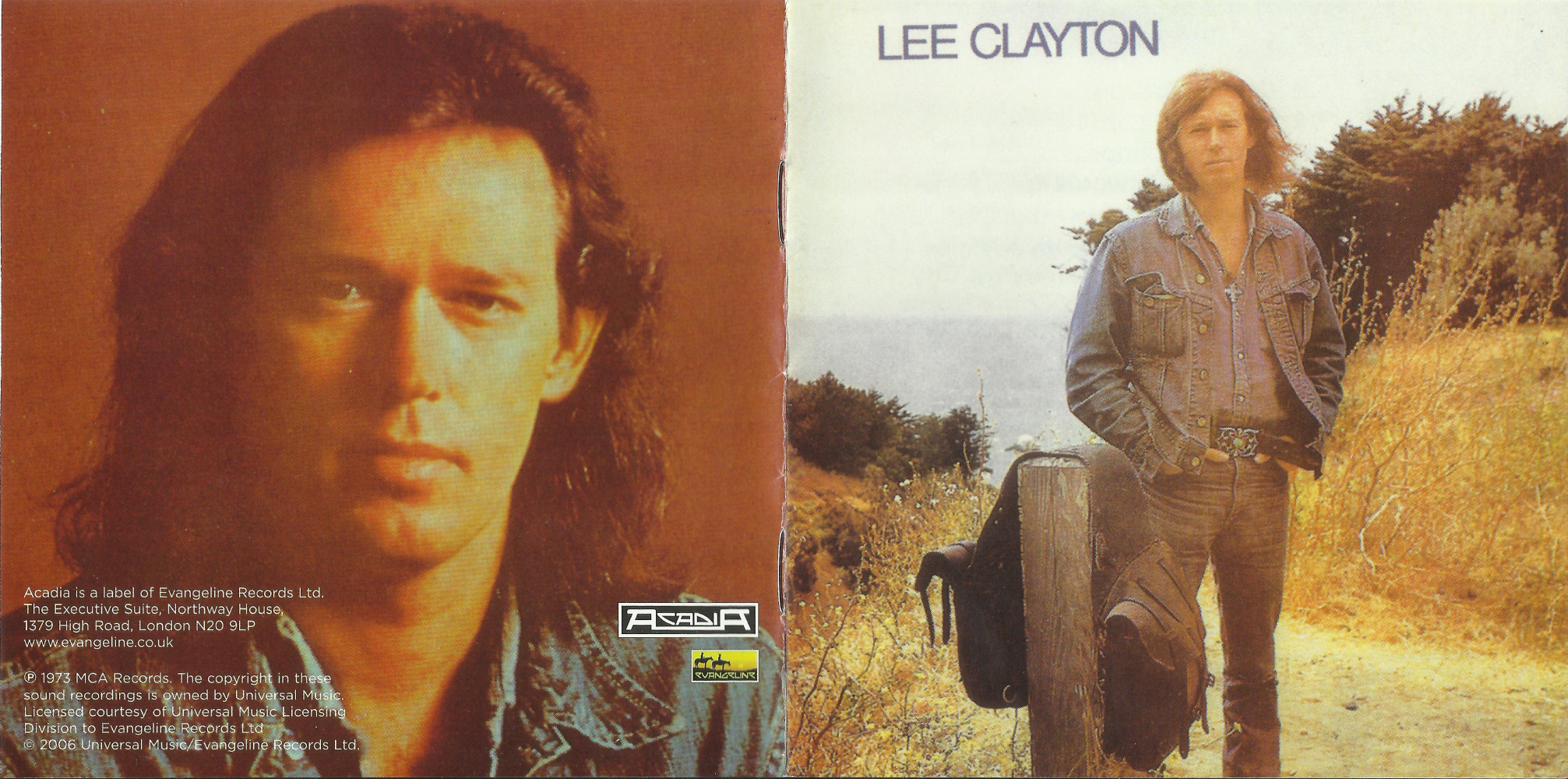
Review (Alan Robinson) : Clayton left the services to pursue a potential career as a singer-songwriter. In the aforementioned interview, Clayton recalled his attempts to find a way in to the Nashville singer-songwriting circle: "I was living in Louisville, Kentucky, and I'd.... spend three or four days a week in Nashville. (When) people would say to me 'What are you doing?', I'd say Tm a poet and songwriter'. Within six months, my money started to go and they took my credit cards away from me and I was on the street. Sold my Porsche and I had an old beat-up Volkswagen. I went from then until I got some money from the record company when I signed the deal in early 73. (Before that) it was out on the street, sleeping on the floor time". His first major success came with the song that gave 'Outlaw1 country its name, Ladies Love Outlaws, originally recorded by The Everly Brothers on their 1972 album, Pass The Chicken And Listen, and taken into the US Billboard Country singles chart by Waylon Jennings in the same year. Ironically enough, Jennings didn't even want the song (or the album it came from) released; it ended up giving its name to a movement in which he would become one its icons. Indeed, it's probably by far Clayton's best known number - artists such as Tom Rush, Confederate Railroad (on the soundtrack of the movie Maverick, which starred Jodie Foster and Mr 'Hi there sugar tits' himself, Mel Gibson) and Jimmy Rabbit have tendered their own take on record over the years. Such success and notoriety saw Clayton score a record deal with the MCA label. MCA had broadened their musical horizons in the early 1970s, signing the future giants of 'Southern Rock', Lynyrd Skynyrd, and also started feeling out talent in other musical genres. The first fruit of the liaison was the album you're hopefully playing now, simply entitled Lee Clayton. From the cover on in, it's apparent that Clayton had been around a bit, done his fair share of dues paying before he set foot in a recording studio. The cover features a long-haired, somewhat careworn individual, in a country setting, looking more like a drifting hitch-hiker than a Nudie Cohen-suited 'hat' act from the Nashville production line. A cursory introduction to the album's musical content reveals that Clayton is possessed of a voice that is similarly rough around the edges - but a perfect vehicle for his intimate, ruminative and pleasingly melancholy songs. Indeed, melancholy is the overall mood that permeates the album in an emotive and appealing way. It's not, however, the kind of melancholia of a Hank Williams or a Ray Price; no, what Clayton parlays is a contemporary take on Romantic desolation. Whereas Hank would've contrasted the existential hillbilly longing of / Can't Help It If I'm Still In Love With You with up-tempo hee-hawing like Settin' The Woods On Fire, Clayton's songs are more urban, and negotiate a different emotive register - equally as affecting, mark you, but firmly rooted in the here and now, at least the here and now of the early 1970s. Also (and you couldn't ask for more from a debut album), Clayton's debut is a bunch of well-crafted, melodically strong and considered collection of songs that showed great promise. Lee Clayton was produced by Chip Young - his career has seen him provide like services on albums Billy Swan, Joe Ely, Mickey Newbury and Delbert McClinton amongst many others. The album also contains musical contributions from a talented bunch of session musicians, whose names will be familiar to fans of the music that's emanated from Nashville over the last thirty years. These include such Music Row luminaries as Tim Drummond (bass), Mickey McGee (drums), and Buddy Spicher (fiddle). Bonnie Bramlett also gets to provide some backing vocals, too. There's also a personal dedication from Clayton to Waylon (Jennings), Kris (Kristofferson), and Billy Joe (Shaver) - a nice acknowledgement from one talented singersongwriter to his influential contemporaries - Clayton would latterly have more reasons to thank Jennings and Kristofferson, as we shall see. The centrepiece of the album is the composite New York City Suite 409. In the space of its six minutes plus duration, Clayton skilfully elides two songs together - Lord She Don't Belong In New York City, and Don't You Think It's Time To Come Home. The first part finds Clayton in thoughtfully sombre mood, yearning for his lover who's in far off NYC, and his skilful description of the missing main squeeze's homespun ways paints a vivid mental picture. It's also obvious a concurrent strand running through the piece is the notion that she's not coming back, which makes the second half of the song all the more poignant, Clayton's lyrical and vocal understatement only adding considerably to the emotive sucker punch that the song ultimately delivers. To me, this illustrates Clayton's songwriting talents brilliantly; a complex emotional range put across simply and effectively. Your attention is drawn to the female vocal in this song that adds a pleasingly femme ying to Clayton's masculine yang - it's supplied by none other than Carly Simon, whom, one surmises, is likely the subject of Clayton's credit on the original album jacket: "Special thanks to a lovely lady from New York City". I'm duty bound to point out the presence on bass on this track of one Dennis Linde - often erroneously credited as the composer of the dreamy sixties folkie hit Elusive Butterfly (that was actually Bob Lind - Dennis will be best-known to you as the composer of arguably Elvis Presley's best latter-day record, Burning Love, as well as composer of songs recorded by Garth Brooks (Callin' Baton Rouge), Mark Chesnutt (Bubba Shot The Juke Box), George W Bush's favourite Country act, The Dixie Chicks (Goodbye Earl) and even our very own Dr Feelgood (No Mo Do Yakamo). Elsewhere, Clayton turns his attention to the Country staples of drinking (Bottles of Booze), and the wooing of women (Mama, Spend The Night With Me) - I'm not sure how successful Clayton was with the lady in the latter, but at least he achieved a modicum of artistic success in crafting a fine contemporary Country seduction song. Clayton, somewhat inevitably, perhaps, chooses to end the album with his most famous song (up until then), Ladies Love Outlaws, and his version, whilst not the definitive item, serves to illustrate the depth and range of his songwriting skills - it's not the best track herein, but would still be a standout item on most singer-songwriters' albums. Lee Clayton - the album, was not a huge sales success, even if its artistic success justified MCA's signing him in the first place. Interviewed a few years later, Clayton was philosophical about it's commercial failure: "I think at some point in time people will understand what I've been trying to do. At the time, it was a very well kept secret. What happened to it was... who knows what happens? It's just one of those things. I had a shot, I rolled my dice and was fortunate enough and worked to a point where I could make a record album. It didn't sell a whole bunch, but that's just part of it. It knocked me out at the time that somebody thought enough about me that I could even put it down on plastic".