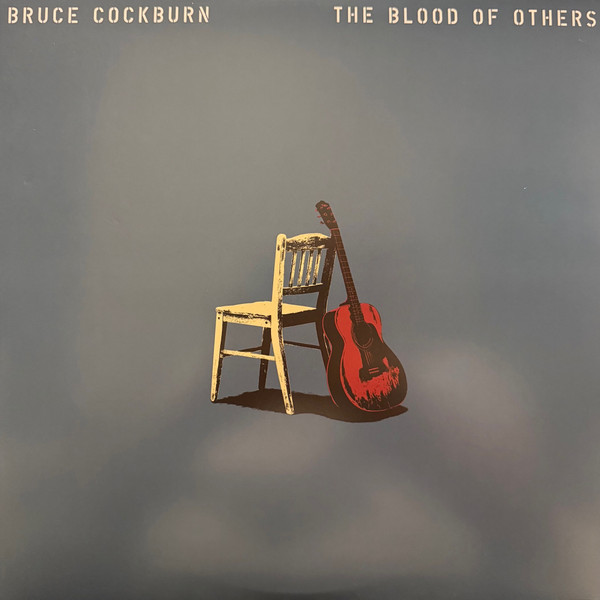
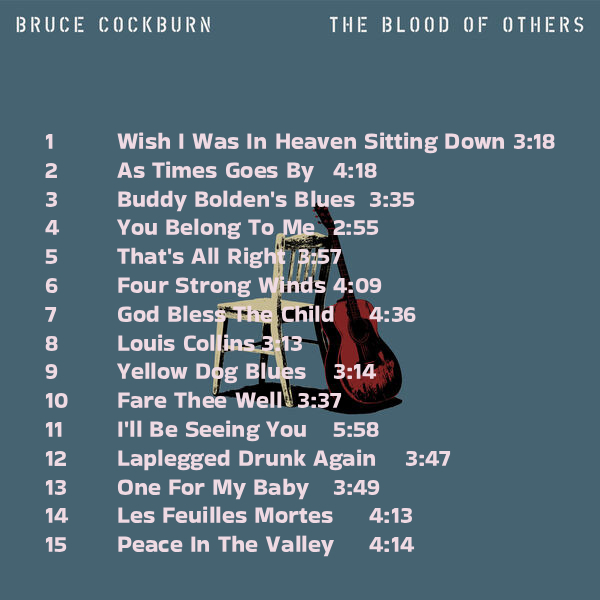
BRUCE COCKBURN : THE BLOOD OF OTHERS
- Wish I Was In Heaven Sitting Down
- As Time Goes By
- Buddy Bolden's Blues
- You Belong To Me
- That's All Right
- Four Strong Winds
- God Bless The Child
- Louis Collins
- Yellow Dog Blues
- Fare Thee Well
- I'll Be Seeing You
- Laplegged Drunk Again
- One For My Baby
- Les Feuilles Mortes
- Peace In The Valley
Label : Sunset Blvd Records
Length : 59:20
Release Date : October 16, 2026
Review (Americana UK) : If you were asked to vote in a poll of the most activist artists in modern popular music or were minded to vote in a poll of the best singer-songwriters or greatest guitarists, it is most likely that you would leave off the name Bruce Cockburn, the Canadian from Ottawa who has flown largely under the radar, despite having possibly been the most awarded singer in Canadian music; many Juno awards for his albums, honorary doctorates from several universities, lifetime achievement awards and a member of the Canadian Songwriters Hall of Fame. As an acoustic fingerpicking guitarist, he is almost without peer, as anyone who has listened to his instrumental albums Speechless in 2005 and Crowing Ignites in 2019, or who has seen him perform live, can attest. His albums are full of literary lyricism, and although many of his songs are known only to aficionados, a number of them have been recorded by other artists. His most famous songs are Lovers in a Dangerous Time, about hanging on to hope in a time of global tensions – his famous line from that song, “got to kick at the darkness till it bleeds daylight”, became the title of a tribute album as long ago as 1991 (Kick at the Darkness). If I Had a Rocket Launcher was probably his most famous protest song, written after a visit to the Guatemalan refugee camps. They both appear on what is probably his most well-known album, Stealing Fire from 1984. Or maybe it was If a Tree Falls, from Big Circumstance in 1988, a critique of environmental destruction. Until now, he has released 38 albums, with subject matter covering soul-searching and spiritualism, political observation, and environmental issues. He has written about love and loss and fear and faith, and produced one of the very best and most original Christmas albums, Christmas, in 1993. He has made albums of gentler folk stylings as well as more rock-inspired albums and has tinkered with many different styles of production; jazz, blues, reggae, and so on, each one featuring to a greater or lesser degree his unique guitar playing. And now, in 2026, he has come to produce his first album of covers, songs that have influenced or inspired him over his musical life, which largely started at the esteemed Berklee School of Music in Boston in the mid-60s when he was 20 years old. Some of the choices are sentimental favourites; others are interesting vehicles for exploring the fingerboard style of guitar-playing. All of them connect to times and places that remain shadings on the map of a life, as he describes the song choices. Blood of Others is almost exclusively just Cockburn on acoustic guitars, which he plays beautifully in service to the songs, which cover gospel, blues, ballads, folk, and jazz genres. Cockburn has explained that certain songs have been drifting around in his mind for many years, and some have been chosen as they work very well as exercises in his fingerstyle. The title comes from a book by Simone de Beauvoir written during the wartime Nazi occupation of France and deals specifically with personal responsibility in the face of oppression, a concept he felt appropriate when recording songs that he did not write. Now in his 80s, his voice is not quite as powerful as it once was, but the empathy and emotion that he has always demonstrated still remain, and that almost seems to be more appropriate to the songs he has chosen. The guitars he plays are entirely suited to the style of the song; take, for example, the classical style he plays on the French chanson classic Les Feuilles Mortes (known in English as Autumn Leaves), which he sings entirely in French, with its original semi-spoken introduction. The solo on this track is mesmerising. He semi-speaks again on As Time Goes By, an intro rarely used to preface the song, but it gives extra weight to it, especially as he changes the words “Yet we get a trifle weary / With Mr Einstein’s theory”, to “Yet we get a trifle weary / with AI and Quantum Theory”. These last are two of five songs, effectively from The Great American Songbook. Johnny Mercer wrote the English lyrics to Autumn Leaves and co-wrote One for My Baby (made famous by Frank Sinatra); the others are You Belong to Me with lovely bass lines courtesy of superstar bassist Viktor Krauss, who also appears on the desperately slow and intensely moving I’ll Be Seeing You (recorded in memory of a brief heart-breaking relationship), with a stunningly fine acoustic guitar solo and soft organ swirls towards the end from regular Cockburn contributor Janice Powers. On only a few tracks is there any additional instrumentation; Colin Linden adds some fine acoustic guitar on Arthur Crudup’s That’s All Right, Mama (made famous by Elvis but slowed right down here), with Scotty Moore’s guitar being the influence on Cockburn on this track. Lonnie Johnson’s Laplegged Drunk Again is one of a number of outright blues songs, which again displays Cockburn’s outstanding fingerpicking style. Yellow Dog Blues and the brilliant Buddy Bolden’s Blues, with its growly vocal and jazzy roots, are others. All of the songs have relevance to Cockburn’s life, marking memories of when he first heard them or the influence they had on his musical life; such as hearing a certain guitar style that he wanted to explore on the album (eg Mississippi John Hurt’s fingerpicking style on his blues Louis Collins, a sad murder ballad). There are a couple of gospel-infused songs, the better one being Robert Wilkins’ Wish I Was in Heaven Sitting Down, a conversation with God, with Cockburn in fine voice. He also delves into folk music with a lovely rendition of fellow Canadian Ian Tyson’s Four Strong Winds, with a perfect intro of the tune on guitar and later followed by another amazing solo, as Linden adds a little dobro for effect. And also in a folksy mode is Fare Thee Well, which he sang with The McGarrigle Sisters at Pete Seeger’s 90th birthday bash. We should also mention the longest track on this 60-minute album, which is Billie Holiday’s God Bless the Child, with yet another exquisite solo as the tune takes on a bluesy feel with a jazzy influence. Cockburn has probably flown under most people’s radar, but just put this album on, retire under some decent headphones and wallow for an hour in this brilliant album, an outlier in Cockburn’s huge catalogue, and come out mesmerised by his interpretive ability and his guitar mastery.
Review (Americana Highways) : This is a beautiful album. Especially from a singer whose been around for years & is known for his own songwriting. Here, Bruce Cockburn honors the tunes that shaped the road toward his own success. 5-decades into that career he is Canada’s other epic singer-songwriter/guitarist (the other 3 are Joni, Neil & Gordon). It’s a brave attempt when a singer who has made his signature sound through his own work risks not always coming across when out of his comfort zone. Bruce Cockburn Artists like Frank Sinatra, Elvis, Johnny Mathis & Billie Holiday, among others, built their careers singing other people’s songs. They had the expertise of interpretation. Not easy. Mr. Cockburn (guitars/vocals) starts excellently with an acoustic guitar cruise through an old gospel tune “Wish I Was In Heaven Sitting Down” but the classic “Casablanca” tune “As Time Goes By” & the gospel song “Peace In the Valley” may be out of Bruce’s range. But the sincere effort is still commendable. Both remain touching ballads with all the nostalgia to keep it flavorful & not soupy. Whereas the 3rd & 9th track sound like Bruce pulls some sips of gin from the Tom Waits catalog. Nice growly voiced “Buddy Bolden’s Blues” & again with the Bessie Smith oldie “Yellow Dog Blues” addresses them vividly, with grit & charm. There are 15 choice cuts on the appropriately titled The Blood of Others (Dropped Oct 16/Sunset Boulevard Records/59:10), a title lifted from a Simone de Beauvoir novel. The LP was produced with skill by Colin Linden (electric & acoustic guitars/dobro) & recorded in Nashville, TN. The surprise? A cover of the early Elvis Presley rocker “That’s Alright Mama,” recorded also by its writer Big Boy Arthur Crudup. Bruce gives it an edge while many others who cover it just sing it. His version is closer to Crudup, & I hear that possibility. Elvis added the rockabilly style. There isn’t a weak song here. Bruce simply does some better than others. Billie Holiday’s 1939 classic “God Bless the Child” works serenely as an acoustic guitar ballad with Bruce’s warm take. Yes, it’s an updated version that purists won’t embrace, but he doesn’t push it out of bounds. He keeps it middle-of-the-road-easy; it’s never a lounge-singer piece. That’s the trick. This isn’t the Bruce of “Tokyo,” “Fascist Architecture” & “Lovers In a Dangerous Time.” This is the seasoned & marinated Cockburn. They don’t call singer/songwriter’s like Bruce Cockburn an artist for nothing. This is a brave undertaking. If music has color — Bruce covers the musical canvas with bold strokes.
Review (Folk Alley) : A peripatetic singer and songwriter, Canadian troubadour Bruce Cockburn continues to explore fresh musical territory on his 39th album, ‘The Blood of Others.’ On the album, he offers a bit of a retrospective on his career, performing songs written by other artists that have shaped his musical landscape. Moving from the blues to ragtime to pop standards to the spirituals, Cockburn captures the emotional resonance of each song in spare treatments that feature only his gritty vocals sung over his ringing guitar picking and strumming. Bright circling fingerpicking lie underneath the reverberating gospel blues of Robert Wilkins’ “Wish I Was in Heaven Sitting Down.” Cockburn’s spacious vocals and richly reverberating jazz arpeggios capture the ache of yearning in Howard Hupfeld’s “As Time Goes By”; Cockburn includes his own updating of the song’s preamble. With growling vocals sung over swaying ragtime guitar, Cockburn delivers his striding version of “Buddy Bolden’s Blues,” while Cockburn’s sunny strolling take on Mississippi John Hurt’s “Lousi Collins” belies the song’s dark themes of murder and death. Tenderly rendered, “Fare Thee Well” evokes the almost mournful pining of a woman whose lover has deserted her, while shimmering strums flow under the slowly unfolding pop standard “I’ll Be Seeing You.” Cockburn’s echoing take on Ian and Sylvia’s “Four Strong Winds” captures the song’s deep longing, while he offers a jaunty, swinging version of the Elvis Presley hit “That’s All Right” (written by Arthur “Big Boy” Crudup). The album closes with a benediction: an uplifting and atmospheric version of the gospel standard “Peace in the Valley.” ‘The Blood of Others’ is a gem of an album, as Cockburn shares many of his many musical influences by offering innovative takes on these songs even within their traditional structures.
Review (The Artsstl) : Imagine a late summer day after the merciless sun has finally set. Dinner plates have been cleared from the table, and you hear voices in the street as neighbors venture outside to relish the trace of a breeze stirring the willows. The outdoors are cooling faster than the indoors as shadows start to stretch from the doorway to the street, but the humidity is still casting its drowsy spell. You slouch into an empty chair on the front porch, your head bobbing at random intervals as you struggle to keep your eyes open. Your uncle relishes those precious evening hours and sets his guitar on his lap. He strolls leisurely through his mental catalog of songs, feeling out the mood of the evening. He finds a promising thread, winds around the chords a few times, tugs at the melody bit-by-bit with a hum and an affirming grunt, and your head snaps to attention as a neatly wound ball of musical yarn comes tumbling out across the hot, shady lawn in the form of a beloved and aptly chosen song. This is the scene I like to set for myself as I listen to Bruce Cockburn play a selection of fifteen songs embedded in his psyche, a psyche that has shared with the world a collection of 39 albums, including this latest addition, The Blood of Others. The mood on the porch on this particular evening feels wistful and reflective. It resonates with memories so distant that the details are fuzzy but the feelings they evoke are still vivid. It’s curious with the knowledge that departures are inevitable and still infinitely disarming. Bruce Cockburn is first of all a guitarist, and a singer-songwriter by immutable talent. His catalog runs deep, and his inspiration is built on a foundation of guitar legends. The selection he presents on The Blood of Others takes us on a tour of lyrically lean but powerful and melodically haunting songs, most originating in the first half of the 20th century, many made famous in the ’50s and ’60s by such names as Billie Holiday, Bob Dylan, and Elvis. These songs are sourced from the roots of blues music and formed the core of Cockburn’s style. Many of these songs have likely been played on many a languid front porch. The album opens with “Wish I Was in Heaven Sitting Down,” a song written in the 1920s by Reverend Robert Wilkins, recorded in 1956 along with the Georgia Sea Island Singers, and resurfaced popularly by R.L. Burnside in 2000. It anticipates mortality, considers the relief it must bring, and still doesn’t sound fully resigned to the transition. Neither is Cockburn ready to retire his craft. Is there a song that conveys ‘departure’ more famously than “As Time Goes By” by Dooley Wilson sitting at the piano in Casablanca? The timeless film came out around the time Cockburn was born and translates well into an acoustic guitar composition with his emotional voice. Driving home that front porch feeling is “Buddy Bolden’s Blues,” dating back to 1939 and known by a number of other names, all deriving from audiences singing along while Buddy Bolden, and eventually Jelly Roll Morton, would strum it out. As the blues go, this one could churn along on repeat, building on a story with a new installment with each pass. Cockburn gives it a charmingly gruff couple of lines and a jaunty strum that I could listen to for hours. One of the teariest and most delicate selections is Cockburn’s treatment of “You Belong to Me,” first recorded by Joni James in 1952. This stripped-down version gives “Somewhere Out There” vibes and could be a lullaby, if the child is young enough to miss the sadness in the lyrics. One of the best-known selections is “That’s All Right,” made famous by Elvis in 1956. True to his roots influences, Cockburn’s version here leans more classic as the song was originally written and performed by Arthur Crudup in 1946. “Four Strong Winds” was unfamiliar to me, but it is apparently canon in Cockburn’s native Canada. It was famously recorded by Ian Tyson of Ian & Sylvia fame and was voted by CBC Radio One listeners as the greatest Canadian song of all time. Cockburn’s voice sounds emotionally exhausted here, appropriately, as he channels the tiresome struggle to stay warm and positive in the face of cold, driving winter. The collection includes two songs made famous by Billie Holiday, the first being “God Bless the Child.” The patina on Cockburn’s voice serves him well to lend some Holiday swagger, with a gentle vibrato and a touch of husky texture. I had the good fortune of interviewing Bruce Cockburn in 2024, and he mentioned Mississippi John Hurt as one of his earliest influences. I love hearing him play Hurt’s 1928 tune “Louis Collins” and imagining the budding guitarist stage of his life. WC Handy’s “Yellow Dog Blues” digs even deeper into musical history—written in 1914—and summons a little soulful growl from Cockburn. While “Fare Thee Well” predates both Hurt and Handy, first recorded in 1908, it has been performed by many of Cockburn’s heroes and peers, including Bob Dylan and Pete Seeger. It comes across as second nature, something Cockburn’s fingers are compelled to play in idle moments, and it sees a hint of flourish in its treatment compared with other selections. “I’ll Be Seeing You” is another selection probably best known in its Billie Holiday version, and with two opportunities now I sense a trace of Holiday’s melancholy in Cockburn’s voice, beyond their shared need to speak out against injustice. This is one of the few tracks with additional instrumentation, and the whisper of accompanying organ enhances the sentimentality. I was surprised by the selection of Lonnie Johnson’s “Laplegged Drunk Again.” The love of the bottle is not a common theme in Cockburn’s music, but the blues picking is, and his reverence for the bluesman helps him find his way to the feeling. Follow this with another drinking song—“One for My Baby”—and it seems the loneliness of closing time and an emptying room that perhaps draws Cockburn into those drunken shoes. I don’t know that I’ve ever heard Cockburn’s French voice before this album. What a delight. I don’t know if it’s the song itself—“Les Feuilles Mortes” a.k.a. “The Dead Leaves”—or the language or the chords or the make this feel so heartbreakingly resigned, but this made my eyes a little foggy. Contrast that with the closer, “Peace in the Valley,” which sounds weary but strong, and it seems this collection has been the perfect tour through the life of a wizened human who excels in getting people to walk in others’ shoes. Honestly, I would’ve been happy with a playlist of influential songs curated by Cockburn. But to hear his voice render so many emotions through his own playing and singing of pieces that meant so much to him is another gift he has given us. And this collection gives us more than the sum of its parts—it gives us imagination, pondering how Cockburn personally connects with each piece, the impression that each selection has left on his sound and style, and the motivation for each choice of just fifteen songs from a lifetime of inspiration. For someone who agonizes over writing a Top Ten of anything, this seems a Herculean task. By that token, I would gladly welcome another of these albums. Sing us another song, Uncle Bruce!
Review (Steve Stockman's Soul Surmise) : Canadian songwriter Bruce Cockburn has been playing finger dancing melodies on the fretboard of my heart, soul and mind for almost 40 years, since Alan McIlroy introduced me to one of my favourite records of all time, Dancing In The Dragon’s Jaw. That he did it on Magdala Street, less than 100 yards from Fitzroy, the church I am now minister in, is not lost on me.
It was in that church some thirteen years ago that I ascended the stairs to find Mr. Cockburn warming up for a gig. I stood back, the door ajar, as he sat at a table playing Shipwrecked At The Stable Door to no one, unaware of my loitering with sacred intent.
Loyal as I am to Bruce, there was a decade that delivered records that were not in keeping with his very best and then his 2023 album O Sun O Moon was a stunner.
So I was delighted to hear that at 81 years of age there was another Cockburn record coming. Then I was stopped in my excited tracks on hearing that The Blood Of Others would be a covers record.
I shouldn’t have been disappointed.
This is a beautiful record. The album cover, just a guitar leaning against a chair, tells you all you need to know about the arrangements. Sparse, leaning on Cockburn’s finger dancing on that fretboard with meticulous precision. Intricate but not complicated. Think of those 70’s records… oh my!
Bruce’s voice is in fine form for his age too. He uses it to give us a wide and wild variety of songs, not from his contemporaries but songs that have journeyed with him longest, since before his own career began.
So Bing Crosby, sits alongside Elvis Presley who sit alongside Billie Holliday and Mahalia Jackson. There are favourite old songs of mine, As Time Goes By, that I know from Bryan Ferry; Four Strong Winds that I know from Neil Young; God Bless The Child that so many have covered and surely an influence on Bruce’s own God Bless The Children.
Then there are songs I’d never have heard but for this record - Buddy Bolden’s Blues, Louis Collins and Laplegged Drunk Again.
All are bookended between two eschatological choices, Wish I Was In Heaven Sitting Down (“Take away sin and give me grace”) and Peace In The Valley. Bruce is holding out for hope on a record named after Simone de Beauvoir’s novel. In the sleeve notes Cockburn writes about the book:
“Among other things it deals with personal responsibility in the face of scary oppression, and the kinds of choices people make. I have borrowed the title because it seems perfect for an album of songs I didn’t write.”
I would take more of this.